
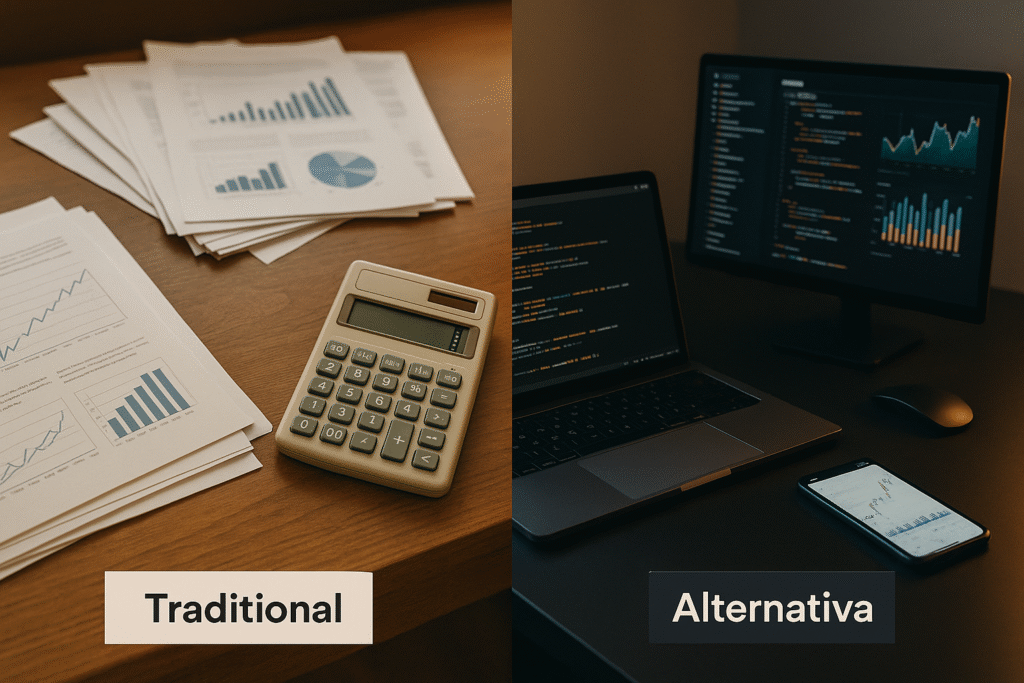
What’s better for investing: alternative or traditional data? The answer depends on your goals. Alternative data offers real-time insights from sources like satellite imagery and credit card transactions, helping you spot trends early. Traditional data, like earnings reports and economic indicators, provides reliable, regulated benchmarks for long-term analysis.
Here’s a quick breakdown:
- Alternative Data: Timely, detailed, but costly and complex to manage.
- Traditional Data: Reliable, accessible, but slower and less granular.
Best approach? Combine both. Use traditional data for stability and alternative data for faster, more precise decisions. Together, they give you a sharper edge in today’s competitive markets.
Kai Wu: Unlocking Alpha by Harnessing Alternative Data and Modern Technology
Alternative Data: Sources, Benefits, and Challenges
Alternative data is changing the way markets are analyzed by providing real-time insights into economic activity, consumer behavior, and emerging trends. These data sources often predict movements ahead of official reports, giving users a valuable edge.
Main Sources of Alternative Data
Alternative data comes from a variety of sources, including credit card transactions, satellite imagery, web traffic, ESG metrics, geolocation data, patent filings, job postings, and employee reviews.
- Credit card transaction data is particularly useful for tracking consumer spending habits across sectors and regions. It reveals patterns like shifts in retail performance, restaurant visits, and seasonal spending trends.
- Satellite imagery offers a unique perspective by monitoring physical economic activity. For example, investment firms use it to analyze parking lot occupancy at retail stores, oil tank levels, and crop yields, providing insights into company performance and commodity prices.
- Web traffic and digital footprint data allow analysts to track website visits, app downloads, search trends, and online reviews. This data can identify consumer interest and brand momentum before these trends appear in financial reports. Social media sentiment, processed with natural language processing (NLP) tools, can even predict stock price changes and market swings.
- ESG (Environmental, Social, and Governance) metrics are increasingly valuable as sustainable investing gains traction. This includes tracking carbon emissions, monitoring labor practices, and assessing corporate governance. Supply chain data, like shipping manifests, also sheds light on global trade and inventory levels, which affect commodity prices and manufacturing stocks.
- Geolocation data from mobile devices reveals foot traffic patterns at retail locations, real estate activity, and even economic recovery trends, such as during the COVID-19 pandemic. Meanwhile, patent filings, job postings, and employee reviews provide early clues about innovation, hiring trends, and shifts in workplace culture.
These diverse sources highlight the broad potential of alternative data but also set the stage for discussing its benefits and challenges.
Benefits of Alternative Data
One of the biggest advantages of alternative data is its timeliness. Traditional earnings reports are released quarterly, but alternative data provides continuous, real-time insights. This allows investment professionals to spot trends early and act on opportunities before official announcements.
Another benefit is its granularity. Unlike traditional data, which often summarizes information at the company or industry level, alternative data can zoom in on specific locations, demographics, or product categories. For instance, a hedge fund analyzing retail stocks can use foot traffic data for individual stores instead of relying on aggregate sales figures.
The predictive value of alternative data is especially useful for quantitative strategies. NLP models that analyze news sentiment, social media chatter, and analyst reports can forecast short-term price movements with greater precision than traditional tools. These models process vast amounts of data, uncovering patterns that human analysts might overlook.
Alternative data also provides insights into sectors that are harder to evaluate using traditional metrics. For example, technology companies may show strong user engagement or app download trends well before these translate into revenue growth. Similarly, ESG data can flag potential risks, such as regulatory issues or reputational damage, that might not yet appear in financial statements.
Finally, alternative data is helping to level the playing field. Subscription services now make these data sources accessible to mid-sized investment firms, enabling them to compete more effectively with larger institutions that previously had exclusive access to proprietary research.
Challenges with Alternative Data
Despite its advantages, using alternative data comes with significant challenges. Complex integration is a major hurdle. Unlike standardized financial reports, alternative data is often messy – coming in different formats, with varying levels of quality and frequency. Building the infrastructure to collect, clean, and analyze this data requires substantial investment in both technology and skilled personnel.
The high costs of premium data feeds and the technology needed to process them can strain budgets. Some data feeds cost hundreds of thousands of dollars annually, and firms must also invest in infrastructure and talent. For smaller firms, the return on investment may not be immediate or guaranteed.
Data quality and validation are ongoing concerns. Unlike traditional financial data, which is audited and regulated, alternative data lacks consistent oversight. Satellite images can be obstructed by weather, social media sentiment can be distorted by bots, and credit card data may have sampling biases. Ensuring reliability requires rigorous validation processes.
Privacy regulations in the U.S., such as the California Consumer Privacy Act (CCPA), add another layer of complexity. These laws impose strict rules on how personal data can be collected and used. Firms must ensure compliance, which can limit data availability and increase costs.
Another challenge is the signal-to-noise ratio. Social media platforms, for example, generate massive volumes of data, but only a small fraction is actionable. Developing algorithms to filter useful insights from irrelevant information requires advanced machine learning and constant refinement.
Regulatory uncertainty also poses risks. The Securities and Exchange Commission (SEC) is still evaluating how alternative data fits into existing regulations, particularly concerning material non-public information and fair disclosure rules. Firms must navigate these gray areas carefully to avoid compliance issues.
Finally, hiring the right talent is a significant obstacle. Successful alternative data strategies require experts who understand both finance and data science. These professionals are in short supply, and the competition to hire them drives up costs, potentially delaying implementation for firms looking to adopt alternative data solutions.
Traditional Data: Strengths and Weaknesses
While alternative data provides timely and detailed insights, traditional data remains the backbone of investment decisions. Its verified benchmarks are essential for long-term analysis and understanding market fundamentals.
Main Sources of Traditional Data
Traditional data originates from regulated financial disclosures and official economic reports, which companies and government agencies are required to publish. Here are its key sources:
- Financial Statements: These include quarterly 10-Q reports and annual 10-K filings submitted to the Securities and Exchange Commission (SEC). They provide standardized metrics such as revenue, earnings per share, debt-to-equity ratios, and return on equity – core tools for evaluating company performance.
- Regulatory Filings: Beyond financial statements, documents like proxy statements (DEF 14A), insider trading reports (Forms 3, 4, and 5), and shareholder disclosures (13D and 13G) offer insights into executive pay, board composition, ownership changes, and potential conflicts of interest.
- Economic Indicators: Published by government agencies, these include employment data, Federal Reserve interest rate decisions, and GDP growth figures from the Bureau of Economic Analysis. They help investors assess macroeconomic trends impacting sectors or markets.
- Market Data: Historical stock prices, trading volumes, dividend payments, and corporate actions (e.g., mergers or stock splits) are sourced from exchanges like the NYSE and NASDAQ. This data fuels technical analysis and quantitative models.
- Credit Ratings: Agencies like Moody’s, Standard & Poor’s, and Fitch provide creditworthiness ratings for corporations and governments, influencing borrowing costs and fixed-income investment decisions.
These regulated sources ensure the dependability of traditional data, which is further explored through its strengths.
Strengths of Traditional Data
The foremost advantage of traditional data lies in its reliability and standardization. Financial statements adhere to Generally Accepted Accounting Principles (GAAP), enabling consistent comparisons. For instance, you can confidently evaluate Apple’s profit margins against Microsoft’s or track Amazon’s revenue growth over time.
Regulatory oversight adds another layer of trust. The SEC mandates independent audits of financial statements, and executives must certify their accuracy under the Sarbanes-Oxley Act. This legal accountability ensures a level of credibility often missing in alternative data.
Traditional data also offers a long historical record, which is invaluable for analyzing trends and market cycles. Stock price data spans over a century for some companies, while financial reporting goes back decades. This historical depth allows investors to study market behavior during events like the Great Depression or the 2008 financial crisis.
Another benefit is the accessibility of traditional data. SEC filings are freely available, and market data can be obtained through various platforms. This accessibility levels the playing field, allowing individual investors to access the same foundational data as institutional players, even if they lack advanced tools.
The standardized nature of traditional data also supports market efficiency. When earnings reports are released, investors can quickly assess results using familiar metrics, enabling rapid decision-making. This shared understanding helps markets process information effectively.
Finally, relying on audited financial statements and official economic data provides legal protection for investment decisions. This compliance reduces liability risks compared to using unverified alternative data sources.
Despite these strengths, traditional data comes with notable limitations.
Weaknesses of Traditional Data
One major drawback is its backward-looking nature. Financial statements reflect past performance, often lagging behind real-time events. For example, quarterly reports are typically filed 40 to 90 days after the period ends, leaving investors with outdated information during critical decision-making windows.
Traditional data also lacks granularity. A retailer’s quarterly revenue figure won’t reveal which stores are thriving, which products are top-sellers, or how customer preferences are shifting. This aggregated view can obscure key details that influence performance.
Another challenge is market saturation. Since traditional data is publicly available, it provides little competitive edge. Analysts spend significant resources trying to extract insights from information that has already been thoroughly examined by others.
Additionally, the flexibility of GAAP accounting can sometimes muddy comparisons. Companies may use different revenue recognition methods, depreciation schedules, or reserve calculations, making financial statements less comparable than they initially appear.
Emerging business models also pose a challenge for traditional metrics. For instance, companies like Facebook (now Meta) generated immense value through user engagement and data long before these activities were reflected in traditional revenue figures.
Lastly, traditional data offers limited insights into operational efficiency or competitive positioning in real time. A manufacturing company’s quarterly report might not reveal supply chain disruptions or competitive threats until these issues significantly impact financial results – often months after they first arise.
These limitations underscore why many investors now pair traditional data with alternative sources to better capture real-time market dynamics.
sbb-itb-ae4776d
Head-to-Head Comparison: Which Data Type Wins
This section dives into the differences between alternative and traditional data, highlighting where each shines in the world of quantitative finance. Knowing these distinctions is key to tailoring data strategies to meet specific investment goals.
Alternative Data vs Traditional Data Comparison
| Attribute | Alternative Data | Traditional Data |
|---|---|---|
| Timeliness | Updated frequently, often in real time or daily | Reported quarterly, with delays in availability |
| Source Diversity | Includes sources like satellite images, social media, credit card data, and web scraping | Mainly derived from financial statements, regulatory filings, and economic indicators |
| Granularity | Offers highly detailed, localized insights (e.g., store-level sales) | Provides broader, aggregated company-wide metrics |
| Predictive Power | Great for spotting short-term trends and market sentiment shifts | Strong foundation for long-term fundamental analysis |
| Cost/Complexity | More expensive and demands specialized analytics skills | More affordable and easier to access |
| Regulatory Oversight | Less standardized, with varying quality controls | Strictly regulated, with mandated audits and compliance standards |
| Integration Challenges | Requires advanced tools and significant data cleaning | Standardized formats simplify integration |
This table provides a snapshot of how the two data types differ, setting the stage for a deeper dive into their unique strengths and limitations.
Key Advantages and Disadvantages
Alternative data stands out for its ability to detect early signals in fast-changing markets. It offers a competitive edge by capturing nuanced, market-moving insights before they appear in traditional datasets. That said, alternative sources can sometimes lack context, contain biases, or require careful validation to ensure reliability.
On the other hand, traditional data benefits from a well-established regulatory framework, ensuring accuracy and legal defensibility. Audited financial statements offer a trusted foundation for analysis, especially for institutional investors. Its broad availability also levels the playing field, making it accessible for anyone conducting fundamental research. However, its reliance on historical information can leave investors blind to emerging trends, a gap that alternative data is better equipped to fill.
U.S. Regulatory and Market Factors
The effectiveness of both data types is also shaped by external influences like U.S. regulations and market dynamics. For traditional data, strict reporting standards ensure accuracy but come with delays, limiting its real-time utility. Meanwhile, privacy laws such as the California Consumer Privacy Act require alternative data to be anonymized or aggregated, which can reduce its detail and usability.
Regulations around sensitive information add another layer of complexity for alternative data users, making compliance a critical part of working with these sources.
In the U.S. market, the rapid absorption of information into asset prices reduces the alpha potential of traditional metrics alone. At the same time, the dominance of institutional investors drives demand for the timely and unique insights that alternative data provides. Together, these regulatory and market factors play a crucial role in shaping how investors can effectively combine both data types to optimize their strategies.
How to Use Each Data Type Effectively
To get the most out of your investments, it’s crucial to align different types of data with specific goals and understand when each can deliver the best results.
Matching Data Types to Your Investment Goals
Short-term strategies thrive on the immediacy of alternative data. Real-time insights are especially useful for day traders and swing traders, who rely on market signals to detect movements before they’re reflected in quarterly reports.
Long-term value investing benefits from the reliability of traditional data. Investors focused on multi-year horizons often analyze audited financial statements, cash flow trends, and debt-to-equity ratios – data that offers stability and regulatory oversight.
Event-driven strategies require a blend of both data types. For example, merger arbitrage funds use traditional metrics to evaluate deal fundamentals while turning to alternative data for signals that indicate the likelihood of a deal’s completion.
Sector rotation strategies apply each data type in unique ways. Traditional indicators like GDP growth and unemployment rates inform broad allocation decisions, while alternative data offers more granular, timely insights to refine sector-specific choices. This dual approach aligns with the idea that timing and detail are key to generating alpha.
Combining Both Data Types for Better Results
While each data type has its strengths, combining them creates a more comprehensive view of the market. Traditional data serves as the backbone, offering insights into a company’s financial health and competitive standing. This reduces the risk of making decisions based solely on short-term signals.
Alternative data, on the other hand, sharpens timing. For instance, traditional analysis might identify a fundamentally strong company, but alternative data can signal when market sentiment shifts in its favor, making it the right time to act.
This combination also strengthens risk management. Traditional metrics provide a baseline for assessing risk, while alternative data offers timely warnings about potential volatility. Together, they support more accurate position sizing and better downside protection.
How ExtractAlpha Supports Your Data Strategy
ExtractAlpha simplifies the process of integrating traditional and alternative data, offering tools and datasets that make this hybrid approach more manageable. For example, their platform includes resources like Estimize, which provides up-to-date earnings estimates that complement traditional fundamental analysis by reflecting current market sentiment.
Their predictive analytics tools turn complex alternative datasets into actionable trading signals, helping investors quickly derive insights without getting bogged down in raw data.
Another key feature is their robust historical data, which allows users to backtest strategies across different market conditions. This helps validate performance and reduces uncertainty during the strategy development phase.
ExtractAlpha also offers in-depth research materials and white papers that guide investors on how to effectively combine traditional and alternative signals in quantitative models. These resources are especially helpful for teams transitioning to hybrid strategies.
Designed with quantitative hedge funds in mind, ExtractAlpha’s datasets enhance traditional financial metrics, enabling investors to adopt an integrated approach. This not only improves performance but also strengthens risk management, making it easier to achieve consistent, risk-adjusted returns in today’s competitive markets.
Conclusion: Key Takeaways
Summary of Key Findings
When it comes to data strategies, the key is leveraging the strengths of both traditional and alternative data. Traditional data remains the cornerstone of investment strategies, offering reliable, standardized, and audited information. This data supports valuation models, risk assessments, and regulatory compliance. Financial statements, market data, and reference datasets provide the consistency and comparability that long-term investors rely on.
On the other hand, alternative data shines in its immediacy and detail, offering real-time insights that can identify trends before they surface in quarterly reports. From satellite imagery to social media sentiment, alternative data has grown into a vital tool for tactical decision-making, complementing traditional analysis.
Each type of data has its challenges. Traditional data can lag and often focuses on historical trends, while alternative data may face issues with quality, interpretation, and cost. The best strategies integrate both, using traditional data as a stable foundation and alternative data for early detection and timely insights.
Final Recommendations
To make the most of these insights, start with traditional data as your base. Use it to build strategic models, valuation frameworks, and risk management systems where reliability and auditability are critical. Then, layer in alternative data for tactical advantages, concentrating on datasets that have demonstrated predictive value through rigorous testing.
For example, in a U.S. consumer discretionary model, you might combine web traffic and credit card spending data to forecast revenue growth. Here, alternative signals help with timing, while traditional data ensures robust risk management.
Establish strong governance from the outset. Link alternative signals to key performance indicators (KPIs), implement quality checks to ensure data reliability, and maintain thorough documentation for compliance. To avoid overfitting noisy data, focus on signals that have a clear economic connection to cash flows.
Companies like ExtractAlpha exemplify this hybrid approach. They specialize in identifying and validating high-quality alternative datasets, ensuring these integrate seamlessly with traditional data. Their tools for dataset vetting, feature engineering, and backtesting help reduce noise and compliance risks, making alternative data a complement rather than a replacement for traditional methods.
FAQs
How can investors combine alternative data with traditional data to improve their investment strategies?
Investors can refine their strategies by combining alternative data – like social media trends, satellite images, and supply chain patterns – with traditional data such as earnings reports, balance sheets, and historical market trends. Together, these data sources offer a richer understanding of market behavior, helping to improve predictions and manage risks more effectively.
The key to making this work lies in using advanced analytics tools that can integrate these datasets smoothly. Additionally, having a structured approach to selecting and assessing data sources ensures they are relevant and compatible. By thoughtfully blending these insights, investors can uncover new opportunities, enhance returns, and align their strategies more closely with their financial objectives.
What are the risks and challenges of heavily relying on alternative data for investment decisions?
Relying heavily on alternative data for investment decisions comes with its fair share of challenges. For starters, issues like accuracy, reliability, and timeliness can skew insights, leading to poor decisions. On top of that, acquiring and processing these datasets often comes with a hefty price tag, which can be especially tough for smaller firms to manage.
There are other risks to consider too. Data privacy concerns and navigating regulatory compliance can be tricky, while model risks – like overfitting or inconsistent results – can throw off your analysis. Plus, the credibility and stability of data providers matter a lot. If the quality or availability of their data changes unexpectedly, it can disrupt your strategies.
To address these challenges, focus on thorough validation processes, strong compliance measures, and a solid understanding of how the data aligns with your investment goals. This way, you can make more informed and reliable decisions.
How does U.S. regulation affect the use of alternative data versus traditional data?
The regulatory environment in the U.S. plays a pivotal role in determining how both alternative and traditional data are utilized, especially in finance and investment sectors. Alternative data often comes under tighter scrutiny due to concerns about how it’s sourced, compliance with privacy laws, and its overall legality. For instance, regulations like the California Consumer Privacy Act (CCPA) impose strict limits on how consumer data is gathered and used, making it critical for companies to ensure compliance to avoid legal complications.
On the other hand, traditional data – such as historical financial records – faces fewer regulatory hurdles. This is largely because it’s derived from established, transparent methods that have long been accepted. Still, both types of data must align with changing legal requirements to ensure their proper use and avoid compliance risks. Keeping up with regulatory updates is essential for effectively using these data sources in the U.S. market.